June 16, 2026
The Ultimate Guide to Personalized Jewelry: Materials, Styles & How to Choose
Personalized jewelry is the fastest-growing category in the jewelry industry, and for good reason — in a world of mass production, wearing something made specifically for you feels radical. But with so many options, materials, and personalization types, how do you choose?
This is the guide we wish existed when we started OurCoordinates. Everything you need to know about personalized jewelry — from materials to care to choosing the right piece — in one place.
Types of Personalization
1. GPS Coordinates
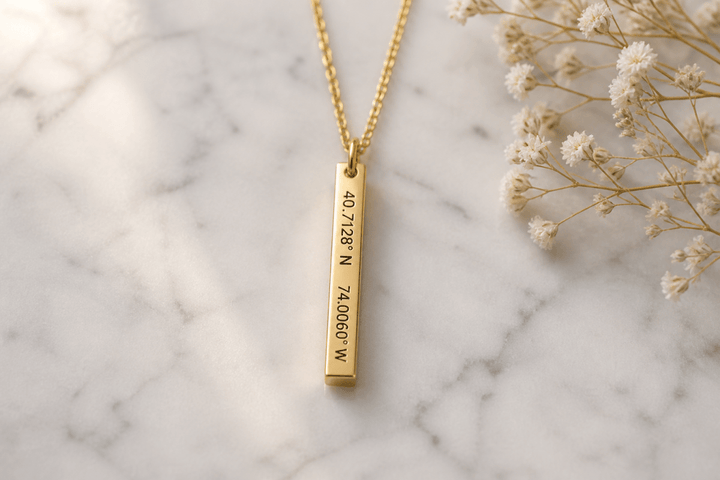
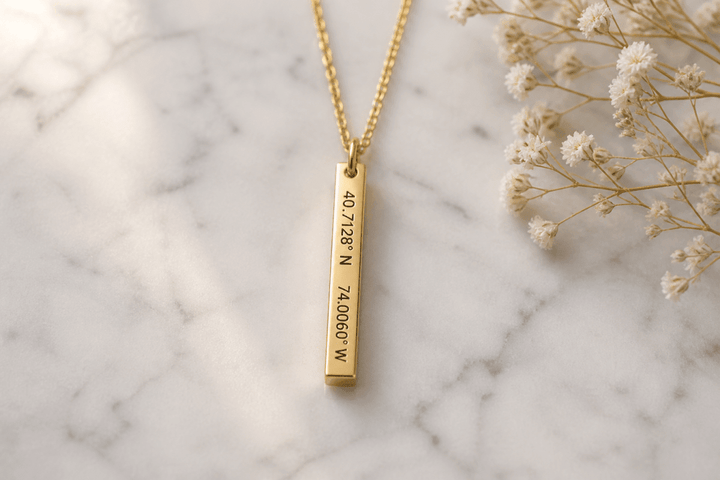
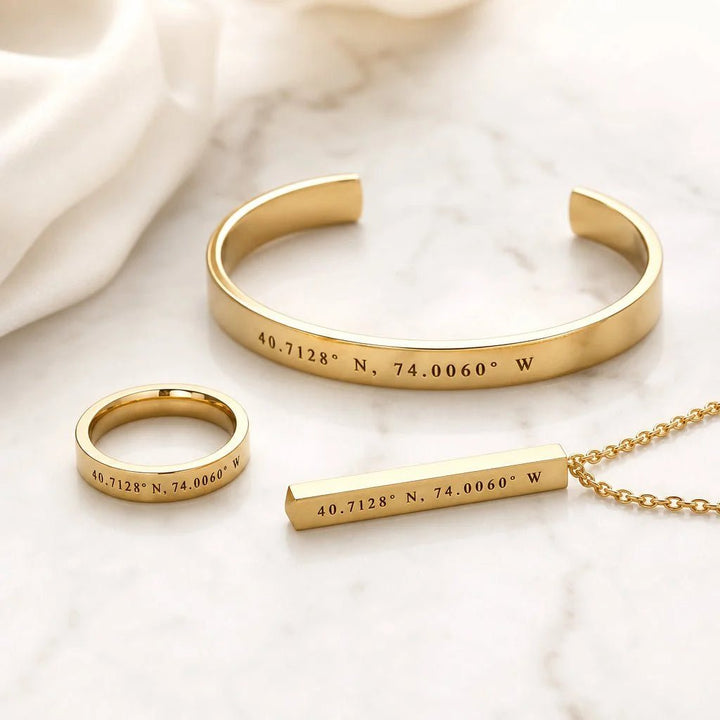
The most meaningful form of personalization. Take the latitude and longitude of a meaningful location and engrave them on jewelry. The beauty is in the subtlety: most people won't know what the numbers mean, but you will. Every glance becomes a private moment.
Best pieces: Custom Coordinates Necklace, Coordinates Cuff Bracelet, Coordinates Dog Tag, Coordinates Flat Band Ring
How to find your coordinates: How to Find Coordinates
How to choose the right location: How to Pick the Perfect Coordinates
2. Names & Initials
The classic. Your name, your child's name, your partner's initial — clean, readable, and immediately personal. Name jewelry has evolved from chunky gold chains to sleek, modern designs you'd never know were "personalized" at first glance.
Best pieces: Custom Vertical Name Necklace, Dainty Horizontal Name Necklace, Cut Out Nameplate Necklace, Custom Initial Necklace for Men
3. Custom Engravings & Messages
Short messages, dates, quotes, or even Morse code. Some pieces offer multiple sides for engraving — the Custom Bar Necklace has four sides, perfect for coordinates on one face, a date on another, and a message on a third.
Ideas: What to Engrave on a Necklace
4. Birthstones
A gemstone representing the birth month of someone you love. Stack multiple birthstones for a family piece. Our Custom Birthstone Ring combines a name with a genuine birthstone for double personalization.
5. Star Maps
A map of the exact star arrangement on a specific date and location. Our Star Map Necklace turns the night sky of a meaningful moment into a wearable pendant. Scientific precision meets emotional depth.
6. Custom Maps
An actual map of a specific location engraved onto jewelry. Our Custom Map Pendant lets you carry a visual representation of a meaningful place — not just coordinates, but the streets, the coastline, the shape of where you belong.
Materials & Finishes
Stainless Steel (Our Standard)
All OurCoordinates pieces are crafted from premium 316L stainless steel — the same grade used in surgical instruments and marine equipment.
Pros:
- Will not fade, tarnish, or rust — ever
- Hypoallergenic — won't irritate sensitive skin or turn skin green
- Waterproof — shower, swim, gym, no problem
- Scratch-resistant — maintains its finish through daily wear
- Affordable — premium quality at accessible prices
Available finishes:
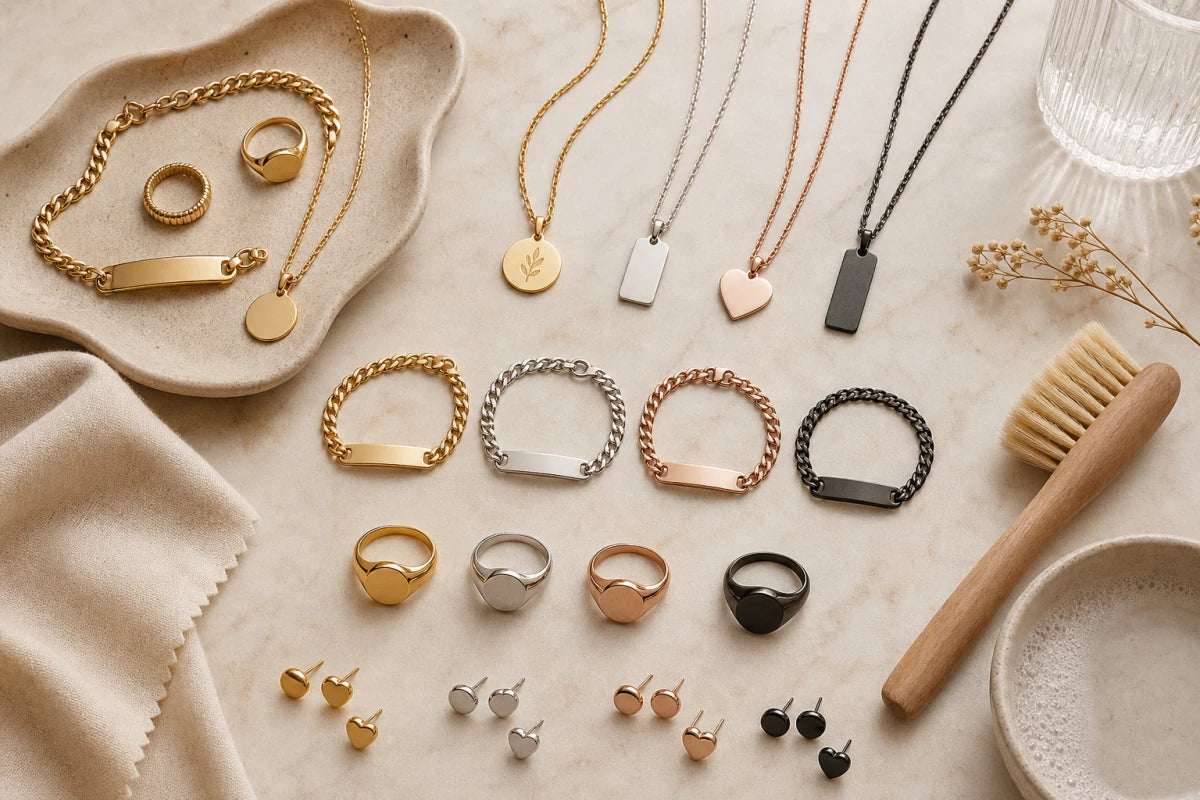
- Gold — Warm, classic, goes with everything. Our most popular finish.
- Silver — Cool, modern, versatile. Great for minimalist styles.
- Rose Gold — Romantic, feminine, trendy. Perfect for gifts.
- Black — Bold, edgy, masculine. Popular for men's pieces.
How Our Materials Compare
| Material | Tarnish? | Waterproof? | Hypoallergenic? | Price Point |
|---|---|---|---|---|
| 316L Stainless Steel (ours) | No | Yes | Yes | $37-$49 |
| Sterling Silver | Yes | No | Usually | $50-$150 |
| Gold-Plated | Eventually | No | Varies | $40-$80 |
| Solid Gold | No | Yes | Yes | $200-$2,000+ |
For a deep dive on gold vs. silver options, read our Gold-Plated vs. Sterling Silver guide.
How to Choose the Right Piece
Step 1: Consider the recipient
- For women: Necklaces are the most popular (Custom Coordinates Necklace, Flat Bar Coordinates Choker), followed by bracelets (Coordinates Cuff Bracelet, Personalized Heart Charm Bracelet)
- For men: Dog tags (Coordinates Dog Tag), leather bracelets (Genuine Leather Coordinate Bracelet), and keychains (Coordinates Keychain)
- For couples: Matching sets (Matching Coordinates Necklaces, Heart Lock Bracelet & Key Necklace Set, Magnetic Couple Bracelets)
Step 2: Choose the personalization
- Most meaningful: GPS coordinates of a shared location
- Most readable: Name or initial
- Most versatile: Custom text or date
- Most visual: Star map or map pendant
Step 3: Pick the finish
- Match to their existing jewelry (most people lean gold or silver)
- When in doubt, gold is the safest choice — it flatters every skin tone
- Rose gold is great for romantic gifts
- Black is best for men's pieces
Step 4: Consider the occasion
| Occasion | Best Pick | Guide |
|---|---|---|
| Anniversary | Custom Coordinates Necklace or Personalized Couple Rings | First Anniversary Gift Ideas |
| Birthday | Coordinates Cuff Bracelet or Custom Vertical Name Necklace | Unique Birthday Gift Ideas |
| Wedding | Matching Coordinates Necklaces | Personalized Wedding Gifts |
| Christmas | Any — see full guide | Best Christmas Gifts |
| Mother's Day | Mama Bear Necklace With Birthstone or Personalized Interlocking Circle Necklace | Mother's Day Gift Guide 2026 |
| Father's Day | Coordinates Dog Tag or Coordinates Keychain | Best Father's Day Gifts |
| Graduation | Dainty Compass Bracelet or Custom Coordinates Necklace | Meaningful Graduation Gifts 2026 |
Care & Maintenance
Premium stainless steel is low-maintenance, but a little care goes a long way:
- Daily wear: Safe to wear 24/7 — shower, gym, sleep, everything
- Cleaning: Warm water + mild soap + soft cloth. Dry thoroughly.
- Storage: Store in the provided pouch or jewelry box when not wearing. Avoid tangling with harder metals.
- What to avoid: Harsh chemicals (bleach, chlorine pools for extended periods), abrasive cleaners, and rough surfaces that could scratch the engraving.
Full care guide: How to Care for Your Jewelry.
Ordering from OurCoordinates
How it works
- Choose your piece — Browse our full collection
- Enter your personalization — GPS coordinates, name, or custom text. Don't know your coordinates? Enter the city name or address and we'll find them for you.
- Choose your finish — Gold, silver, rose gold, or black
- We handcraft it — Each piece is engraved to order, not pulled from a shelf
- It ships to you — Free US shipping. Processing takes 3-5 business days.
What you get
- Premium stainless steel jewelry, made to order
- Elegant gift packaging
- Free US shipping
- 30-day return policy
- Backed by 500K+ pieces sold and 5-star reviews
More Guides & Gift Ideas
- Top 10 Meaningful Gifts — ranked by emotional impact
- How to Pick the Perfect Coordinates — how to choose the perfect location
- What to Engrave on a Necklace — 50 engraving ideas
- Best Personalized Gifts for Girlfriend / Best Gifts for Boyfriend — gifts for your partner
- Sentimental Gifts for Best Friends — gifts for your best friend
Frequently Asked Questions
Is personalized jewelry more expensive than regular jewelry?
Not at OurCoordinates. Our personalized pieces range from $37-$49 — the same price range as non-personalized jewelry from most brands. Custom engraving is included in the price, always.
How long does it take to make a personalized piece?
Standard processing is 3-5 business days. Each piece is individually engraved to order — no mass production, no shortcuts.
Can I see a preview before you make it?
Our engraving process ensures precision. If you have specific formatting requests, include them in your order notes or email info@ourcoordinates.com before we begin crafting.
What if the engraving is wrong?
Double-check your entry at checkout. If you notice an error before we begin crafting, contact us immediately and we'll fix it. After crafting, our 30-day return policy has you covered.
Is personalized jewelry a good gift if I'm not sure about their taste?
Yes — because the personalization carries the emotional weight, not the design. Even if the style isn't exactly what they'd pick for themselves, the meaning behind the coordinates (or name, or date) makes it irreplaceable. That said, the Coordinates Cuff Bracelet and Custom Coordinates Necklace are universally flattering.
Gold-Plated vs. Gold-Filled vs. Sterling Silver vs. Stainless Steel
These four terms get used loosely across the jewelry industry, and the differences decide whether a piece survives three years of daily wear or turns your wrist green by spring.
- Gold-plated: a microscopically thin layer of gold electroplated onto a base metal. Beautiful, inexpensive, and the layer wears through — faster on bracelets and rings than on necklaces, because friction is the enemy.
- Gold-filled: a thick, pressure-bonded layer of gold, typically 5% of the item's weight — roughly 100 times the gold of standard plating. Substantially more durable, substantially more expensive, and often mislabeled as "plated" by sellers who do not know the difference.
- Sterling silver (925): 92.5% silver, 7.5% alloy. Solid all the way through, so it cannot wear off — but it tarnishes, which is reversible with a polishing cloth in about a minute.
- Stainless steel (our standard): does not tarnish, does not turn skin green, tolerates showers, gyms, saltwater, and deployment. It is why we use it for pieces intended to be worn daily and never taken off.
The short version: for something worn every day without thinking about it, stainless steel. For a dressy piece worn occasionally, sterling silver. For a gold look on a budget, gold-plated — with the expectation that it will need care. For a gold look meant to last, gold-filled.
Sensitive Skin
Green skin and irritation are almost always a nickel reaction from the base metal under worn-through plating, not from the gold itself. If the recipient has reacted to jewelry before, choose stainless steel or sterling silver and skip plated pieces entirely. This one decision prevents most "she loved it but can't wear it" outcomes.
How Engraving Is Actually Done — and Why It Affects Durability
The engraving method is invisible on day one and very visible in year three.
- Laser engraving uses a focused beam to alter or remove the surface. It handles fine detail, small fonts, and long coordinate strings with precision, and the mark is part of the metal rather than a coating. This is what most modern coordinates jewelry uses.
- Rotary (CNC) engraving physically cuts with a spinning bit, producing a deeper, more tactile groove. Excellent on thicker pieces, less suited to tiny type.
- Etching uses acid to bite the design into the surface — common in bulk production, softer edges.
- Printing or heat transfer sits on top of the metal. It looks like engraving in photographs and wears off. If a listing does not say how the personalization is applied, assume this one.
On plated pieces, engraving cuts through the plating by definition, which is why a laser-engraved plated item shows wear at the lettering first. Another argument for solid metals when the piece carries something you do not want to fade.
Making Each Finish Last
Sterling silver: store it dry and airtight; polish with a silver cloth when it dulls. Gold-plated: last thing on, first thing off — perfume, lotion, and chlorine strip plating faster than anything else. Stainless steel: soap and water. That is the whole routine. Full detail in our jewelry care guide.
Frequently Asked Questions
Does gold-plated jewelry turn green? The gold does not. The base metal underneath can, once the plating wears through.
Can I shower with it? Stainless steel, yes. Sterling silver, occasionally. Gold-plated, no.
Can I mix metals? Yes — the "all one metal" rule is dead. Mixed stacks look deliberate when one metal clearly dominates.
Which is best as a gift if I don't know their preference? Stainless steel in a silver tone. It suits the widest range of skin tones and wardrobes and it survives being forgotten in a gym bag.
Shop the pieces in this guide


Related guides
- The complete guide to personalized jewelry
- How to find the coordinates of any place
- How to style and stack coordinates jewelry
Or browse our coordinates jewelry.